What We Do

01
Emotion Polyregulation
Based on the work of Ford, Gross & Gruber (2019), I am exploring multiple emotion regulation approaches people use such as pursuing different regulation goals, strategies, or tactics. My current work investigates concurrent and/or sequential use of the cognitive reappraisal tactics, reinterpretation and psychological distancing, as a means of understanding natural models of emotion regulation.
Ford, Gross & Gruber, 2019
02
Emotion Regulation
Interventions
I am examining which emotion regulation strategies are most strongly associated with mitigating perceived stress, such as stress related to bereavement, caregiving, and COVID-19 social distancing. I am also examining the moderating influences of relevant individual differences (e.g., age, race, gender, affective style, physical health, and geographic location) on these relationships.

Denny et al., 2024
03
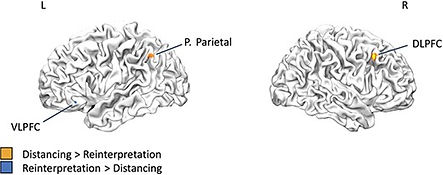
Neurobiological Markers of Emotion Regulation
I am interested in understanding the basic neurobiological mechanisms underlying successful and unsuccessful emotion regulation in both healthy and clinical populations, such as borderline personality disorder and depression.
Denny et al., 2023
04
Emotion, Aging & Health
I am interested in the biological mechanisms through which psychological stress associated with bereavement and caregiving for people with Alzheimer's Disease can dysregulate the immune, autonomic, and endocrine systems, and how this may be moderated by adaptive emotion regulation.

Recent Citations
-
Dicker, E. E., Leal, S. L., & Denny, B. T. (2026). Emotion polyregulation and daily negative affect: predictors of use and strategy-level effectiveness. Anxiety, Stress, & Coping, 1-18.
-
Dicker, E. E., Jones, J. S., Kunik, M. E., & Denny, B. T. (2025). Emotion regulation strategies to improve outcomes in caregivers of people with Alzheimer’s disease and related dementias: A systematic review. Journal of Health Psychology.
-
Denny, B. T., Lopez, R. B.*, Wu-Chung, E. L.*, Dicker, E. E.*, Goodson, P. N.*, Fan, J., ... & Koenigsberg, H. W. (2024). Training in cognitive reappraisal normalizes whole-brain indices of emotion regulation in borderline personality disorder. Biological Psychiatry: Cognitive Neuroscience and Neuroimaging, 9(8), 819-826
-
Hayes, B. K., Harikumar, A., Ferguson, L. A., Dicker, E. E., Denny, B. T., & Leal, S. L. (2023). Emotion regulation during encoding reduces negative and enhances neutral mnemonic discrimination in individuals with depressive symptoms. Neurobiology of Learning and Memory, 205, 107824.
-
Moncada-Jiménez, J., Dicker, E. E., Chacón-Araya, Y., Peralta-Brenes, M., Briceño-Torres, J. M., Villarreal-Ángeles, M., ... & Johnson, D. K. (2023). Exploring Handgrip Strength as a Cross-cultural Updated 08.18.2025 Correlate of Body Composition and Upper Body Strength in Older Adults from Costa Rica and Kansas. Journal of Cross-Cultural Gerontology, 38(3), 223-244.
-
Denny, B. T., Lopez, R. B.*, Jungles, M.*, Goodson, P.*, Dicker, E. E.*, Chavez, J.*, Jones, J. S.* (2023). Unpacking reappraisal: a systematic review of fMRI studies of distancing and reinterpretation. Social Cognitive and Affective Neuroscience, 18(1), nsad050.
-
Goodson, P. N.*, Dicker, E. E.*, & Denny, B. T. (2023). Emotion Regulation Approaches. Lifestyle Psychiatry: Through the Lens of Behavioral Medicine.
-
Dicker, E.E.*, & Goodson, P.*, Denny, B. (2023). The Neuroscience of Emotion Regulation. Oxford University Press.
-
Brown, R. L., Chen, M. A. Paoletti, J., Dicker, E. E., Wu, E. L., LeRoy, A. S., Majd, M., Fagundes, C. P. (2022). Emotion regulation, heart rate variability, and psychological wellbeing among older adults. Frontiers in Psychology, 3284.
-
Dicker, E. E., Jones, J. S., & Denny, B. T. (2022). Psychological distancing usage uniquely predicts reduced perceived stress during the COVID-19 pandemic. Frontiers in psychology, 13.